
Abstract
This opinion article examines the largely unspoken effect of modern domestic technology on companion animals. Written from the perspective of Dr. Blair Felis, it asks whether smart feeders, litter systems, cameras, artificial environments and other pet products primarily improve the animal’s life, the human owner’s convenience, or both.
Keywords: pet technology, feline behavior, smart home, animal welfare, product design, automation, domestication, abandonment.
About Dr. Blair Felis
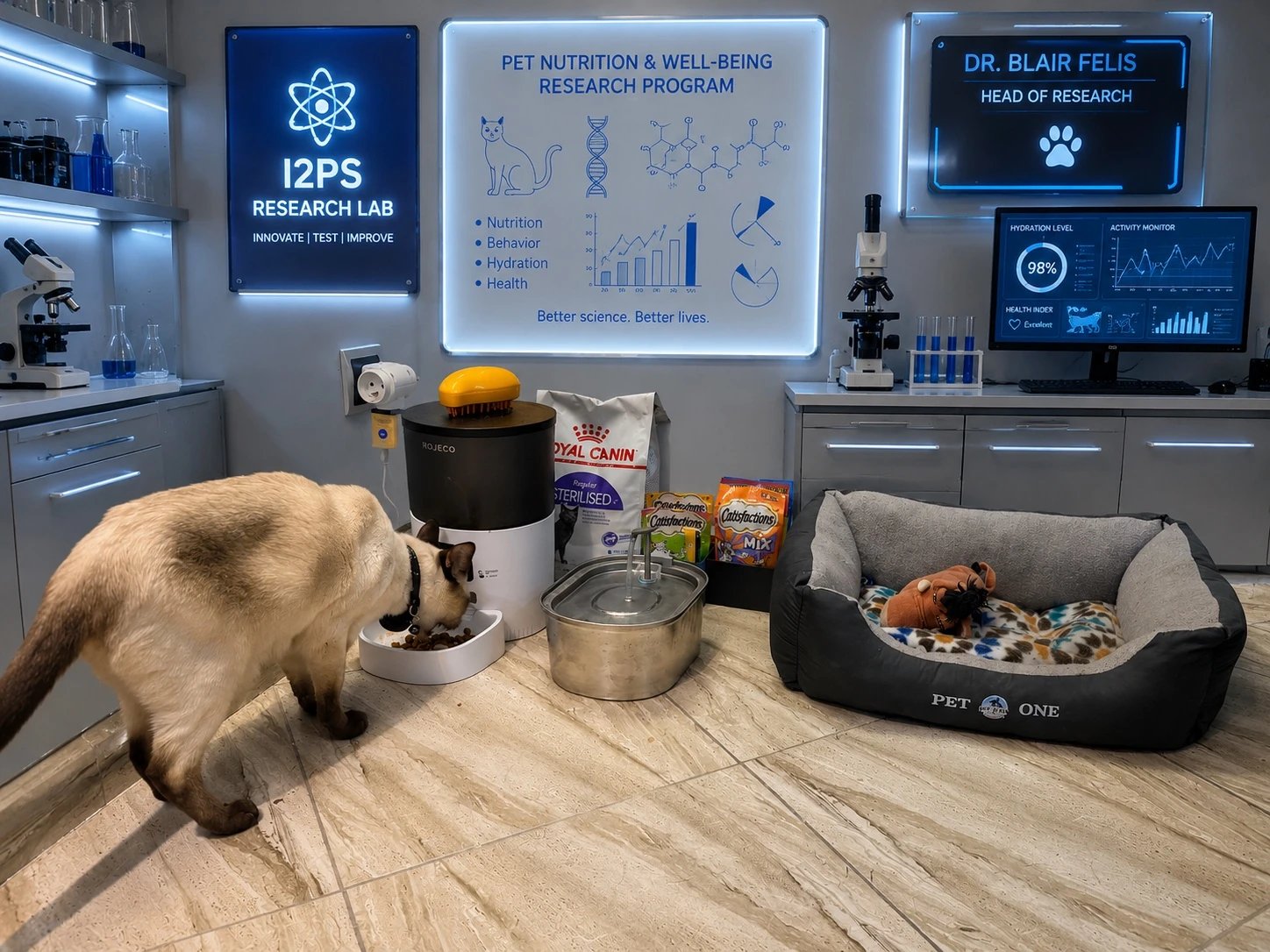
Dr. Blair Felis is a twelve-year-old Siamese seal point cat and Head of Feline Research at the I2PS Research Lab. His work is based on twelve years of direct contact with the domestic environments, materials, devices and routines that humans create around companion animals.
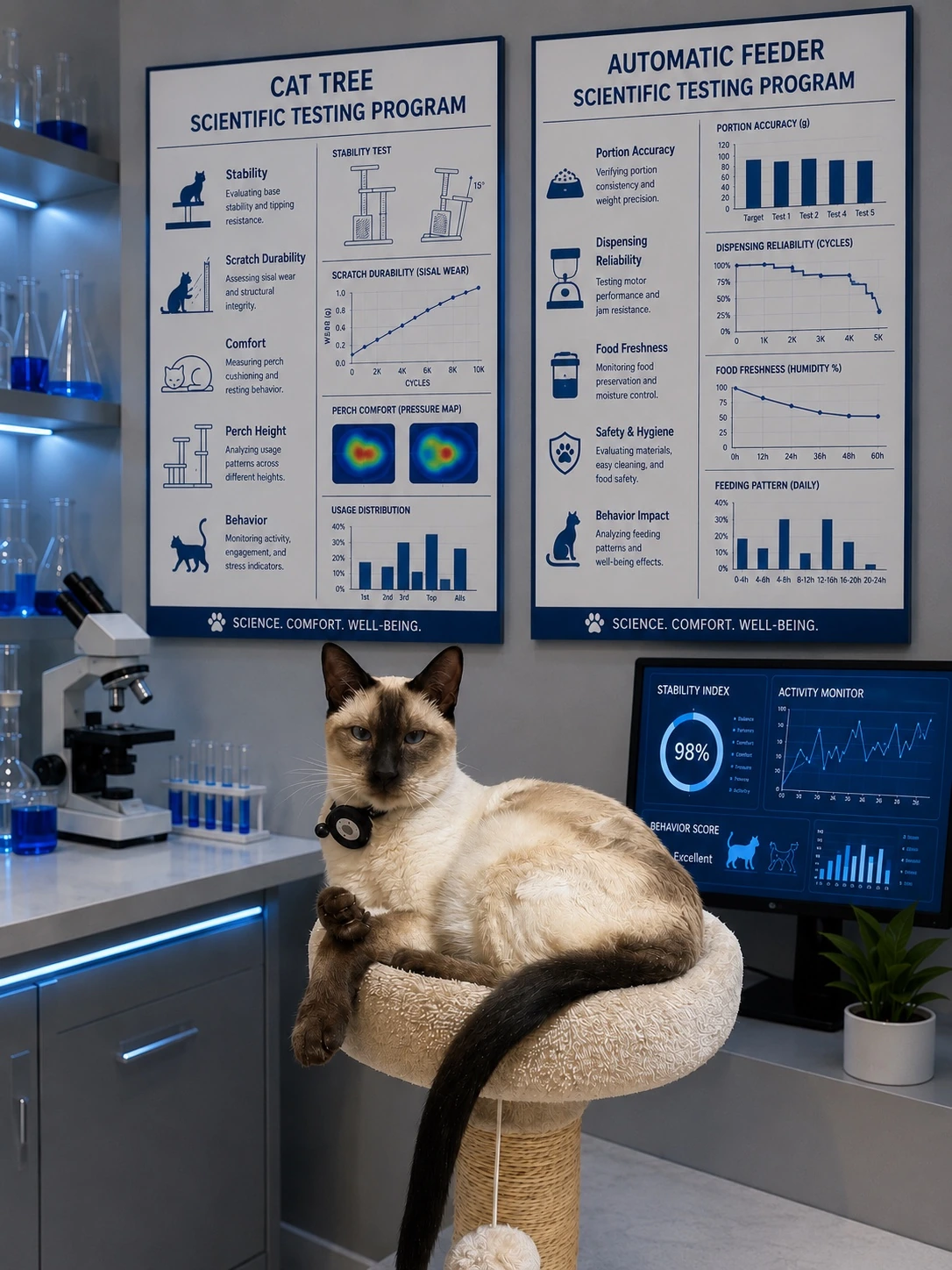
His earliest research focused on the everyday engineering of the home. He examined furniture stability, surface durability, fabric resistance, packaging geometry, cable routing, charging cords, telephone leads, cushions, containers and the structural rigidity of objects that manufacturers had not always expected to undergo feline testing.
These investigations were not limited to whether an object survived. Dr. Felis studied where cats choose to rest, how they climb, which materials attract scratching, how furniture height changes behavior, when an enclosure offers security and when it becomes restrictive, and how apparently minor design decisions can influence comfort and movement.
During the last six years, his research has increasingly concentrated on technology marketed specifically for pets. This includes automatic feeders, water fountains, monitoring cameras, remote speakers, activity sensors, automated toys, smart-home routines and the growing number of devices that place an animal's basic needs behind motors, software, connectivity and human-selected schedules.
Dr. Felis approaches every system from the position that human product research can easily measure reliability while overlooking experience. A feeder may dispense the correct portion and still create anxiety. A fountain may circulate water and still be unpleasantly noisy. A cat tree may remain upright while offering poor movement, unsuitable textures or an uncomfortable resting position.
His work therefore asks a question that appears throughout this article: was the product designed around the animal who must use it, or around the human who purchases, cleans, monitors and controls it?
The two studies shown below represent his current research priorities. The first examines cat-tree stability, scratch durability, perch comfort, height, engagement and behavior. The second examines automatic feeding, hydration, rest, food freshness, dispensing reliability, monitoring systems and the broader effects of replacing human routines with automated systems.
Although the presentation carries a deliberate sense of humor, the underlying subject is serious. Companion animals cannot describe their user experience through surveys or reviews. Their feedback appears through approach, avoidance, posture, appetite, hesitation, sleep, stress and changes in routine. Dr. Felis's role is to remind the human researchers that the silent user must remain at the center of the design.
Editorial Note
Dr. Blair Felis has spent twelve years living beside human technology. His research began with the inspection of furniture, fabrics, packaging, charging cables, telephone cords, household surfaces, food containers and structural rigidity. During the last six years, his work has focused more specifically on the interaction between cats and modern domestic technology, including smart feeders, water fountains, cameras, automated toys, monitoring systems, artificial environments and products marketed for feline well-being. The following opinion article is presented from his perspective.
I have spent twelve years observing human innovation from the floor, the furniture, the kitchen counter and occasionally from inside the packaging in which that innovation arrived.
Humans often describe themselves as the users of technology.
This is not always accurate.
Sometimes they design a product, purchase it, connect it to the internet, install an application and then leave another species to live with the result.
That species is frequently the cat.
The human reads the instructions.
The cat performs the actual testing.
For most of my life, I have examined the relationship between animals and the environments humans create for them. I have tested beds, chairs, cushions, tables, bags, boxes, electrical cords, chargers, fabrics, feeding systems, water containers and many objects that their manufacturers apparently did not realize required feline certification.
More recently, my work has focused on a particular question:
When humans design technology for pets, who truly benefits—the animal, the human, or both?
This is not an argument against technology.
Technology has improved veterinary care, nutrition, identification, safety, communication and the ability of humans to care for animals.
But every new product should still be examined from the perspective of the animal expected to use it.
Humans should not assume that a product benefits a pet merely because the packaging contains a photograph of one.
The Animal Did Not Change
Cats did not suddenly become digital animals.
Our senses did not evolve for smartphone notifications, electric motors, artificial fragrances, security cameras, automated doors or scheduled feeding applications.
Our instincts were not redesigned when humans began living in apartments.
The animal remained largely the same.
The environment changed around it.
For many generations, a cat’s home was not necessarily its entire world.
The home offered food, warmth, shelter and human company. But outside the home, there might also have been soil, plants, rooftops, gardens, walls, wind, sunlight, insects, unfamiliar smells and opportunities to explore.
The animal could move between environments.
It could select a resting place.
It could climb something that was not assembled from printed instructions.
It could investigate its surroundings without requiring a subscription service.
This older way of living was not perfectly safe.
Outdoor environments may expose animals to traffic, disease, poisoning, fights, parasites, extreme weather or disappearance.
Modern indoor living can provide important protection from these risks.
But when the home becomes the animal’s entire universe, every part of that universe is controlled by a human being.
The temperature. The light. The smell. The feeding schedule. The available surfaces. The permitted movement. The location of water. The location of waste. The opportunities for play. The moments of privacy.
The animal may become safer.
It may also become less able to choose.
Humans Recreated the Outdoors Indoors
When pets began spending more of their lives inside, humans attempted to reproduce parts of the natural environment using manufactured products.
Trees became cat towers. Branches became wall-mounted shelves. Soil became commercial litter. Streams became electric water fountains. Hunting became chasing feathers, plastic objects, lights and battery-powered toys. Hidden spaces became fabric tunnels and enclosed beds. Natural exploration became a route between furniture selected by the owner.
The outdoor environment became a catalogue.
Some of these products can be genuinely valuable.
A climbing structure may provide exercise, height and security. A clean litter tray supports hygiene. A water fountain may encourage drinking. A well-designed toy may provide stimulation.
The problem is not that these products exist.
The problem is that humans often assume that buying them completes the animal’s environment.
A manufactured substitute may reproduce one visible part of a natural behavior while missing much of the experience surrounding it.
A cat tower provides height. It does not provide wind, moving leaves, changing scents, sunlight, natural textures or an unpredictable environment.
A toy may imitate prey. It does not necessarily reproduce the patience, movement, sensory information, timing and decision-making involved in hunting behavior.
A litter tray provides a place to eliminate waste. It also places the animal inside a small system whose material, depth, fragrance, cleanliness, position and accessibility were selected by someone else.
Humans built replacements.
They rarely asked whether those replacements were complete.
The Pet Is the User, but Not the Customer
This is one of the most important difficulties in pet technology.
The animal uses the product. The human purchases it.
The product is therefore usually marketed toward the human.
The packaging must attract the human. The features must impress the human. The application must reassure the human. The product must fit inside the human home.
The pet is the user, but it cannot compare specifications, read reviews, request a refund or explain why it dislikes the design.
This creates an unusual engineering problem.
A product can succeed commercially even when the animal does not benefit meaningfully from it.
A scented litter may make the room smell more pleasant to the owner. But was the fragrance selected for the cat’s sense of smell?
An automatic cleaning system may reduce human labor. But was its movement, timing, sound and enclosure studied from the animal’s perspective?
A camera may reassure the owner while away. But does the animal benefit from being watched?
A remote speaker may allow the owner to speak through the camera. But does hearing a voice without seeing, smelling or locating the person provide comfort or confusion?
An automatic toy may keep moving after the animal has lost interest.
The machine records successful operation.
The animal may record a different result.
My Examination of Smart Feeders
For the last six years, I have devoted considerable attention to smart feeding systems.
These devices promise accuracy, scheduling, portion control, remote access, notifications and sometimes identification of individual animals.
From the human perspective, this is impressive.
A meal can be scheduled from another city. A portion can be measured precisely. An application can confirm that food was released.
But the release of food is not the entire feeding experience.
An animal may respond to the sound of the mechanism. It may wait beside the device long before the scheduled time. It may become dependent on a motor, power source, internet connection, sensor or software service that it cannot understand.
If the system fails, the device may report an error.
The cat reports the problem by waiting.
Technology should therefore support feeding, not make the animal’s basic needs dependent on a single point of failure.
A smart feeder should be evaluated not only by asking whether it releases the correct amount of food.
We should also ask whether the mechanism frightens the animal, whether food can become trapped, whether another animal can block access, what happens during a power failure, whether the owner can recognize a malfunction remotely, whether there is a safe manual alternative and whether the schedule serves the animal’s health and behavior or primarily the owner’s convenience.
The device may be smart.
The feeding system is only responsible when these questions are answered.
The Litter Industry
The modern litter industry demonstrates how completely a natural behavior can become a manufactured system.
Cats once used soil, sand, gardens and outdoor spaces.
Indoor cats may now depend entirely on commercial litter and a human-selected tray.
Around this activity, humans created an extensive industry: clumping materials, crystals, plant-based products, artificial fragrances, dust-control formulas, covered boxes, automatic cleaning systems, disposable liners, odor filters, tracking mats and waste containers.
Many of these products solve genuine household problems.
They make indoor pet ownership cleaner and more manageable.
But we should still ask:
Was the system optimized for the animal’s behavior, or for the human’s tolerance of that behavior?
Safety Is Not the Entire Life
Indoor living can protect animals from real dangers.
That protection is important.
But safety alone does not define well-being.
A secure environment can still be boring. A clean environment can still be restrictive. A climate-controlled environment can still lack sensory variety. A well-fed animal can still lack movement, exploration, privacy, decision-making or meaningful interaction.
Humans understand this principle when discussing their own lives.
They do not define a good human existence only as one in which injury is unlikely.
They also value movement, purpose, stimulation, relationships, privacy, choice and a changing environment.
Animals cannot explain these needs using human language.
That does not mean those needs do not exist.
When humans take complete control over an animal’s environment, they become responsible for more than survival.
They become responsible for the quality of the world the animal experiences.
A Good Environment Contains Choices
The question is not whether every cat should be released outdoors.
In many places, outdoor access may be unsafe, impractical or environmentally irresponsible.
The question is whether the indoor environment provides meaningful choices.
Can the animal choose between high and low resting places? Warm and cooler areas? Light and shade? Open and hidden spaces? Social interaction and privacy? Movement and quiet? Soft and firm surfaces?
Can it move away from a machine that creates noise? Can it avoid another animal? Can it retreat from visitors, children or activity? Can it explore something that changes?
A good environment does not merely contain many products.
It contains choices.
An expensive smart home may still be a poor environment if every aspect of it forces the animal into one routine.
Technology Changed Humans Too
Pets do not experience only the devices made for them.
They also experience the devices used by their owners.
Humans now spend large portions of the day looking at phones, computers, televisions and tablets.
A person may sit beside an animal for hours while giving it very little attention.
Physical presence is not always emotional presence.
Notifications interrupt play. Screens delay movement. Online meetings change household routines. Artificial light changes sleep schedules. A human may remain at home all day while remaining mentally elsewhere.
The pet may not understand the screen.
It understands that the person behind the screen is not responding.
Technology therefore affects animals indirectly by changing human attention.
This may be one of its least discussed effects.
The device does not need to interact with the animal directly.
It changes the person with whom the animal lives.
When Pets Became Content
Social media created another role for domestic animals.
Pets became content.
They are photographed, filmed, dressed, awakened, surprised, positioned and encouraged to react for an audience.
Many people share animals out of genuine affection.
Videos can promote adoption, education, veterinary awareness and appreciation for animal life.
But the camera can also change the relationship.
A moment is no longer valuable only because it is shared between the pet and the owner.
It becomes valuable because it may receive attention from strangers.
The animal cannot consent to becoming content.
This does not mean every photograph or video is unethical.
It means humans should distinguish between recording natural behavior and repeatedly creating discomfort to produce a reaction.
The same question appears again:
Who benefited?
Did the activity enrich the animal’s life? Did it strengthen the relationship? Or did the animal become an instrument for human attention?
Data Is Not Understanding
Pet technology increasingly promises data.
Cameras record movement. Collars measure activity. Feeders count portions. Applications record weight. Sensors monitor doors, sleep, drinking and litter use.
This information can be useful.
A change in activity or routine may reveal a problem that deserves attention.
But data can also produce false confidence.
A device may count movement without understanding the quality of that movement. It may record time beside a food bowl without understanding nausea, stress, competition or discomfort. It may classify sleep without understanding whether the animal feels secure.
The more information technology provides, the easier it becomes for humans to believe that the animal has been fully understood.
But the animal is more than its data.
Observation still matters. Touch matters. Routine matters. Knowledge of the individual matters.
A graph should support attention.
It should not replace it.
The Animal Cannot Submit a Review
Human users can explain that a product is uncomfortable. They can report an irritating sound. They can complain about a confusing interface. They can return the product.
An animal cannot complete a survey.
It cannot explain that a motor is frightening. It cannot state that a fragrance is overwhelming. It cannot report that an enclosed design feels unsafe.
Its feedback appears through behavior.
Avoidance. Hesitation. Restlessness. Hiding. Changes in eating. Changes in elimination. Changes in grooming. Disrupted routines.
These behaviors can have many causes and should not be interpreted carelessly.
But they are still forms of communication.
Designing for a silent user requires humility.
The inability of the user to speak should increase the standard of care, not reduce it.
Research Must Ask the Correct Question
A product may pass every technical test and still answer the wrong question.
The feeder released the correct quantity. The cleaning mechanism completed one thousand cycles. The camera remained connected. The collar recorded movement. The water fountain continued pumping.
Technically, the devices worked.
But who benefited from that success?
Did the research examine only reliability, cleaning time, odor, battery life, connectivity and customer satisfaction?
Or did it examine the animal’s stress, sensory experience, natural behavior, choice, adaptation and long-term well-being?
A product made for animals should not be evaluated only by the people buying it.
The animal’s experience must be part of the engineering requirement.
This is not easy.
Animals respond differently. Behavior is complex. Owners can misunderstand what they observe.
But difficulty does not remove responsibility.
It makes better research necessary.
Protection Creates Responsibility
Technology has increased the human ability to protect animals.
It has also increased human control over them.
The more control humans take, the more responsibility they inherit.
If the animal cannot leave the building, the human is responsible for its entire environment. If it cannot search for food, the human is responsible for nutrition and feeding behavior. If it cannot find another water source, the human is responsible for reliable access. If it depends on a machine, the human is responsible for what happens when the machine fails. If it cannot escape noise, heat, light or social pressure, the human must provide relief.
Convenience must never make that responsibility invisible.
Better Technology Begins With Observation
The answer is not to reject pet technology.
The answer is to design and use it with greater care.
Observe the animal before introducing a new system. Introduce changes gradually. Provide alternatives where possible. Allow the animal to choose. Avoid unnecessary fragrances, sounds, lights and movement. Do not assume that expensive means appropriate. Do not assume that smart means beneficial. Do not allow automation to replace daily attention. Design for failure so that food, water, access and safety do not depend on one machine. Study behavior over time. Include engineers, veterinarians, animal-behavior specialists, researchers and experienced owners in the development process.
And ask the question that product marketing may avoid:
Was this designed to improve the animal’s life, or to make the animal easier for the human to manage?
My Conclusion
Has technology improved the lives of pets?
In many ways, yes.
It has supported better medicine, safer homes, improved identification, specialized nutrition, monitoring and protection.
But it has also transformed animals into permanent residents of environments designed almost entirely by humans.
It replaced natural spaces with manufactured products. It replaced some choices with programmed routines. It created industries around behaviors that previously occurred in a larger environment. It gave humans more information, convenience and control.
The remaining question is whether it gave the animal an equally meaningful benefit.
Humans should not assume that a solution is good for an animal merely because it solves a problem for its owner.
Cleanliness is not automatically well-being. Surveillance is not understanding. Protection is not a complete life. Technological sophistication is not proof of responsible design.
I live inside the future humans created.
I sleep beneath their artificial lights. I eat according to systems they select. I use materials they purchase. I interact with objects they install. I experience technology I never requested.
This does not mean the future is bad.
It means the future must be examined from more than one point of view.
I have spent twelve years testing the human world.
Some of it is excellent.
Some of it requires further research.
Several charging cables did not survive peer review.
But behind the humor remains a serious principle:
The animal is not a decoration inside the smart home.
It is one of its inhabitants.
And before humans describe every new pet product as progress, they should ask one honest question:
Who truly benefited—the animal, the human, or both?
The Responsibility That Must Never Be Abandoned
There is one consequence of domestication and technological comfort that is more painful than any failed device.
Abandonment.
A cat raised inside a human home learns a particular world.
Food arrives in a bowl or through a feeder. Water is always available. Temperature is controlled. Doors define the limits of movement. Beds provide warmth. Humans provide protection, routine and companionship.
The animal still carries instincts, but instinct is not the same as experience.
A cat accustomed to an indoor life may suddenly be abandoned in a world it has never been taught to navigate—a world of traffic, hunger, unfamiliar animals, harsh weather, disease, noise and danger.
Humans sometimes speak as though releasing a cat outside simply returns it to nature.
But for a domesticated animal, abandonment is not a return.
It is the sudden destruction of everything it learned to trust.
The more completely humans redesign an animal’s life around comfort, dependence and technology, the greater their responsibility becomes.
We cannot teach an animal that food will arrive, that shelter is permanent and that humans are safe—and then disappear when caring for it becomes inconvenient.
A pet is not a product that can be discarded when its maintenance becomes difficult.
It is a living being whose understanding of the world was shaped by the people who brought it into their home.
Technology may feed the animal. It may monitor it. It may entertain it. It may protect it.
But no machine can replace the promise made when a human accepts responsibility for another life.
The greatest failure is not that a feeder stops working or that a camera loses connection.
The greatest failure is when the human leaves.
Because once an animal has learned to depend on our world, abandoning it means forcing it to survive in a world it no longer knows.
And no level of technological progress can make that ethical.
Felis, B. (2026). “The Silent Animal in the Smart Home.” I2PS Engineering Blog, Article No. 005.